
Appearance
@znight/http available
HTTP controllers for Znight. Routes are analysed by the compiler (paths, parameters, types, schemas, uploads, guards) and served by the adapter of your choice: the built-in node:http server, Fastify, Express or Hono. Every adapter behaves the same, on Node.js 24+ and Bun 1.3+.
sh
npm install @znight/core @znight/http zod
npm install fastify # optional: or express, or hono (+ @hono/node-server on Node.js)ts
import { Application } from '@znight/core'
import { HttpPlugin } from '@znight/http'
import { __ZNIGHT_METADATA__ } from './.znight/container.generated.js'

const app = await Application.create({
  metadata: __ZNIGHT_METADATA__,
  plugins: [HttpPlugin.configure({ port: 3000, prefix: '/api' })], // built-in node:http adapter
})
await app.start() // SIGINT / SIGTERM: stop accepting connections, drain, close
ts
import { HttpPlugin } from '@znight/http'
import { fastifyAdapter } from '@znight/http/fastify'

HttpPlugin.configure({ adapter: fastifyAdapter({ options: { trustProxy: true } }), port: 3000 })
The complete reference (every option, the compiler contract, how to write an adapter) is the package README.
Controllers and routes
ts
import { Body, Controller, Delete, Get, HttpResponse, NotFoundException, Param, Post, Query } from '@znight/http'

@Controller('/users')
export class UserController {
  constructor(private readonly users: UserService) {}

  @Get()
  list(@Query('page') page = 1, @Query('tag') tags: string[] = []) {
    return this.users.list({ page, tags })
  }

  @Get('/:id')
  async get(@Param('id') id: number) {
    const user = await this.users.findById(id)
    if (user === undefined) throw new NotFoundException(`User ${id} not found`)
    return user
  }

  @Post()
  async create(@Body(CreateUser) input: CreateUser) {
    const user = await this.users.create(input)
    return HttpResponse.created(user, `/users/${user.id}`) // 201 + location
  }

  @Delete('/:id')
  remove(@Param('id') id: number) {
    return this.users.remove(id) // undefined → 204 No Content
  }
}@Controller(path?)or@Controller({ path?, scope? }): a provider (singleton by default) whose decorated methods are routes.- Route decorators:
@Get,@Post,@Put,@Patch,@Delete,@Head,@Options,@All. Method decorators:@HttpCode(status),@Header(name, value),@BodyLimit(size)(also on the class),@UseGuard(...),@UseInterceptor(...),@Validate(schema). - Path grammar: static segments,
:nameparameters and a trailing*wildcard. Anything else (regular expressions, optional segments) isZNIGHT007, as are duplicate method + path pairs and:paramswithout a matching@Param(). The most specific route wins (static >:param>*). HEADis served for everyGETroute; unknown paths answer404, other methods405withallow, unmatchedOPTIONS204(bothallowheaders list the same methods,OPTIONSincluded). A trailing-slash policy (strictby default,ignore,redirect, whoselocationalways stays on the same origin) is applied the same way on every adapter.- Routes match the raw request path: dot segments are not resolved (
/files/a/../bgivesctx.params['*'] = 'a/../b'), so never build file paths from parameters without therootoption ofHttpResponse.file(). Exception:Bun.serve()gives the Hono adapter a normalised URL. - Paths can be built from constants:
@Controller(`${API_V1}/users`)is evaluated at build time.
Parameters
| Decorator | Injects |
|---|---|
@Param(name?, schema?) | A path parameter (or all of them without name) |
@Query(name?, schema?) | A query parameter (or the whole query object) |
@Body(schema?) | The parsed request body |
@Headers(name?) | A header (lower-cased name) or all headers |
@Cookie(name?, schema?) | A request cookie (or all of them), coerced like a header |
@SignedCookie(name, s?) | The verified value of a signed cookie |
@UploadedFile(field?, o?) | An uploaded File of a multipart body (Files) |
@UploadedFiles(field?, o?) | The uploaded files of a field (File[]) |
@Ctx() | The adapter-neutral HttpContext |
@Req() / @Res() | The native adapter request / response (escape hatch, warning) |
Coercion. Path, query and header values are strings on the wire; Znight coerces them from the declared parameter type in generated code: string, number, boolean, bigint, Date, literal unions, enums, branded primitives and arrays of those (T[] also accepts a single value). A Date is an ISO 8601 date (2024-01-02), a date-time with an offset (2024-01-02T10:00:00Z, +02:00) or a millisecond timestamp: impossible dates and date-times without offset (they would depend on the server time zone) are rejected. An invalid value is a 400 Bad Request naming the parameter. A type that cannot be coerced from a string is a build error (ZNIGHT007) for @Param / @Headers.
Parameters with a default value, ? or | undefined may be absent (undefined is injected, so default values apply).
Validation
Pass any Standard Schema (Zod 3.24+/4, Valibot 1, ArkType 2, Effect Schema...) to @Body(), @Query() or @Param(), or use @Validate(schema) on the method as sugar for @Body(schema):
ts
import { z } from 'zod'

export const CreateUser = z.object({
  email: z.email(),
  name: z.string().min(2),
  role: z.enum(['admin', 'member']).default('member'),
})
export type CreateUser = z.output<typeof CreateUser>

@Post()
create(@Body(CreateUser) input: CreateUser) {
  // input.role is 'member' when omitted: handlers receive the schema output
}- Handlers receive the schema output (defaults, transforms, stripped keys); async schemas work.
- Failures answer
400withdetails: [{ path, message }](aValidationExceptioncarrying the raw issues, to map with an exception mapper). - Schemas must be exported (the generated module imports them).
- A non-primitive
@Body()or@Query()without a schema is reported asZNIGHT017: a warning, or an error with the compiler'sstrictValidationoption.
Request bodies
Bodies are parsed by Znight (identically on every adapter), after the guards and before the interceptors, for routes declaring @Body() or upload parameters; other routes read them lazily with ctx.parseBody(), ctx.rawBody() (bytes, e.g. for webhook signatures) or ctx.bodyStream().
content-type | Body |
|---|---|
| (empty body) | undefined |
application/json, */*+json | parsed JSON (400 when malformed) |
text/* | string (charset honoured) |
application/x-www-form-urlencoded | record, repeated keys as arrays |
multipart/form-data | record of the text fields; files in ctx.files (Files) |
| anything else / none | Uint8Array |
Bodies above the body limit answer 413 (plugin bodyLimit, 1 MiB by default, or @BodyLimit('10mb') on a route or a controller); a content-encoding other than identity answers 415.
Responses
| Handler returns | Response |
|---|---|
Object / array / number / boolean / null | JSON |
string | text/plain; charset=utf-8 |
Uint8Array / ArrayBuffer | application/octet-stream |
ReadableStream / Node.js Readable | streamed application/octet-stream |
Blob / File | its bytes, with its type and size |
HttpResponse.file() / HttpResponse.stream() | a file or a stream (Files) |
HttpResponse | its body, status and headers |
Web Response | sent as is |
undefined | empty body, 204 (201 for POST) |
Status precedence: @HttpCode(status) > HttpResponse.status > default (201 for POST, 204 without body, 200 otherwise). Headers: content type < @Header < ctx.setHeader() < HttpResponse headers.
Files
Uploads
ts
import { Body, Controller, Post, UploadedFile, UploadedFiles } from '@znight/http'
import { z } from 'zod'

export const AvatarForm = z.object({ title: z.string().min(1) })

@Controller('/profile')
export class ProfileController {
  @Post('/avatar')
  avatar(
    @UploadedFile('avatar', { maxSize: '2mb', mimeTypes: ['image/png', 'image/jpeg'] }) avatar: File,
    @Body(AvatarForm) form: z.output<typeof AvatarForm>, // the text fields of the form
  ) {
    return { size: avatar.size, type: avatar.type, title: form.title }
  }

  @Post('/documents')
  add(
    @UploadedFiles('documents', { maxFiles: 5, maxSize: '20mb' }) documents: File[],
    @UploadedFile('cover') cover?: File, // optional: undefined when absent
  ) {}
}
Uploaded files are standard File objects (name, type, size, arrayBuffer(), text(), stream()), held in memory. @UploadedFile() / @UploadedFiles() without field take the files of any field; @Body(schema?) receives the text fields (Record<string, string | string[]>).
| Option | Default | Description |
|---|---|---|
required | true, unless the parameter is optional | 400 when no file is sent |
maxSize | uploads.maxFileSize (10 MiB) | Maximum size of each file (5_000_000, '5mb', Infinity) |
maxFiles | uploads.maxFiles (10) | @UploadedFiles: maximum number of files |
mimeTypes | any | Accepted types: 'image/png', 'image/*', '*/*' |
Upload routes parse multipart/form-data bodies as they arrive, with Znight's own RFC 7578 parser (not Request.formData(), which buffers everything and differs between runtimes), and reject an invalid upload as soon as the offending part shows up:
| Status | When |
|---|---|
400 | missing required file, text value instead of a file, second file for @UploadedFile, file in an undeclared field, malformed body |
413 | file above maxSize, more than maxFiles files, too many parts, field too large, body above the limit |
415 | refused media type, non-empty body that is not multipart/form-data |
Plugin-wide limits: HttpPlugin.configure({ uploads: { maxFileSize, maxFiles, maxParts, maxFieldSize } }) (defaults: 10 MiB, 10, 1000, 1 MiB). The body limit of an upload route defaults to the sum of what its upload parameters accept plus bodyLimit; @BodyLimit(size) caps it.
Downloads
ts
@Get('/reports/*')
download(@Param('*') name: string) {
  return HttpResponse.file(name, { root: REPORTS_DIR }) // '../../etc/passwd' → 404
}

@Get('/invoices/:id')
async invoice(@Param('id') id: string) {
  return HttpResponse.file(await this.invoices.pathOf(id), { filename: `Facture ${id}.pdf` }) // attachment
}
HttpResponse.file(path | URL | Blob, { root?, dotfiles?, filename?, disposition?, contentType? }) streams the file with Content-Type (from the extension), Content-Length, Last-Modified, ETag and Accept-Ranges, and handles conditional requests (If-None-Match / If-Modified-Since → 304, If-Match / If-Unmodified-Since → 412) and single byte ranges (206, 416 when unsatisfiable). Content-Disposition follows RFC 6266 with a UTF-8 filename* for non-ASCII names. Missing files and paths leaving root (.., absolute paths, symbolic links) or naming dotfiles (.env, .git/) answer 404.
Streaming responses
ts
@Get('/export.csv')
export() {
  async function* lines(users: UserService) {
    yield 'id,email\n'
    for await (const user of users.iterate()) yield `${user.id},${user.email}\n`
  }
  return HttpResponse.stream(lines(this.users), { filename: 'users.csv' })
}
HttpResponse.stream() accepts a Web ReadableStream, a Node.js Readable or an async iterable of Uint8Array / string chunks. The source is read as fast as the client receives the data (backpressure), cancelled when the client disconnects, and runs in the request scope: request-scoped instances are disposed only after the stream has been sent (or cancelled), and the graceful shutdown waits for streamed responses.
Large files
Recommended
For large files, let clients upload directly to object storage with presigned URLs (S3, GCS, R2...): the API authorises the upload and returns the URL, your servers never carry the bytes.
To receive a large file through the API, send it as the raw request body and stream it with ctx.bodyStream() (nothing is buffered; backpressure applies; the route limit still applies):
ts
@Put('/files/:id')
@BodyLimit('5gb')
async store(@Param('id', FileId) id: string, @Ctx() ctx: HttpContext) {
  await pipeline(Readable.fromWeb(ctx.bodyStream()), createWriteStream(join(UPLOADS_DIR, id)))
}
Security
Never trust what the client sends
File.nameis chosen by the client: never use it as a path. Store files under generated identifiers and keep the name as metadata.File.typeandmimeTypesrely on the type the client declares: check the content (magic numbers) when it matters.- Always pass
roottoHttpResponse.file()when the path comes from the request. - Store uploads outside of the web root, and serve user content as an
attachment(or from another domain): an uploaded HTML or SVG file served inline runs scripts in your origin. The default security headers (nosniffand adefault-src 'none'CSP) are a second line of defence: keep them on. - Keep limits tight (
maxSize,maxFiles,@BodyLimit, pluginuploads): uploaded files live in memory.
Errors
Throw HttpException(status, message?, details?) (or a subclass: NotFoundException, ConflictException...) for expected failures:
ts
import { HttpException, NotFoundException } from '@znight/http'

if (user === undefined) throw new NotFoundException(`User ${id} not found`)
throw new HttpException(409, 'Email already used', { field: 'email' })
json
{ "statusCode": 409, "error": "Conflict", "message": "Email already used", "details": { "field": "email" } }Any other error becomes { "statusCode": 500, "error": "Internal Server Error" }: the message is only exposed with exposeErrors: true, and the error is reported to hooks and the logger. Map your own error types to responses with the exceptionMappers option.
Guards
A guard is a provider deciding whether a request may proceed. Apply it with @UseGuard() on a controller or a route, or globally with the guards option:
ts
import { type CanActivate, type HttpContext, UseGuard } from '@znight/http'

@Injectable()
export class ApiKeyGuard implements CanActivate {
  constructor(private readonly config: SecurityConfig) {}

  canActivate(ctx: HttpContext): boolean {
    return ctx.header('x-api-key') === this.config.apiKey // anything but true → 403
  }
}

@Controller('/admin')
@UseGuard(ApiKeyGuard)
export class AdminController {}
Order: global guards → controller guards → route guards. Guards are injected like any provider, and the scope rules apply to them. A guard that enforces route decisions declares them in a static enforces array, checked when the plugin boots.
Route metadata and decisions
Create metadata decorators with createRouteDecorator; values land in the generated route definition (route.meta[key]), readable by guards and interceptors without reflection:
ts
import { createRouteDecorator } from '@znight/http'

export const Public = createRouteDecorator('public', { group: 'access', required: true }) // flag: @Public()
export const Roles = createRouteDecorator<readonly string[]>('roles', { group: 'access', required: true })

@Controller('/stats')
@Roles(['analyst']) // default decision of the controller's routes
export class StatsController {
  @Get('/summary')
  @Roles(['admin']) // the nearest decision wins
  summary() {}
}

// in a guard
const roles = Roles.get(ctx) // the effective value: ['admin'] on /stats/summary- Decorators sharing a
groupare alternatives for one decision: a route (or controller) takes one of them (ZNIGHT005otherwise), and the route's decision replaces the controller's. Withoutgroup, each decorator is its own group. - With
required: true, every route must carry a decision of the group, its own or its controller's: a route without one fails the build (ZNIGHT023). - A guard lists the decorators it enforces (
static enforces = [Public, Roles]): at boot, every route deciding a required group, or a group that a guard class of the application enforces (even a guard registered in no chain, so a forgottenRateLimitGuardis caught), must have such a guard in its chain, otherwise the application does not start (ZNIGHT023, or one warning per group withenforcement: 'warn'). - Without
group, any non-empty key is valid ('auth:public'); an explicitgroupis a name of letters, digits,_,.and-starting with a letter. HttpPlugin.routeslists the effectivemetaand the guard chain of every route: snapshot it to review access changes.
The Security guide builds authentication and authorization on these rules.
Interceptors
@UseInterceptor() wraps route execution (global → controller → route, the first one being the outermost), seeing the context and the result: response mapping, caching, timing. For business-level interception of any provider method, use @Intercept().
CORS
ts
HttpPlugin.configure({
  cors: {
    origin: ['https://app.example.com', /^https:\/\/[a-z0-9-]+\.preview\.example\.com$/],
    credentials: true,
  },
})
CORS is handled by the plugin, the same way on every adapter (the built-in node server included):
- Preflights are answered inside the
http:requesthook, before routing and guards, even when an@Optionsor@Allroute matches:204with the CORS headers,403for a denied origin,404for a path without route. A preflight never gets the401of an authentication guard. - Other replies to an allowed origin (errors,
404,405and redirects included) getaccess-control-allow-origin,access-control-allow-credentialsandaccess-control-expose-headers(the request id header by default);vary: originis merged into every reply. Withorigin: '*'(or'*'in a list), every reply getsaccess-control-allow-origin: *, with or without anOriginheader, and novary: origin: a cached reply then serves CORS and non-CORS requests alike. - A denied origin is served normally, without CORS headers: CORS decides what a page may read, it is not access control.
origin is '*', an origin, an anchored RegExp, a list of them or a function. Options are checked at boot (ZNIGHT005): an origin written with a path or a trailing slash, an unanchored RegExp, '*' or allowHeaders: '*' with credentials, and '*' in the methods, allowHeaders or exposeHeaders lists with credentials (browsers read it literally there). Other options: methods, allowHeaders ('*' never covers Authorization: it is named in the preflight answer when the browser asks for it), exposeHeaders, maxAge (600 s). With Fastify, Express or Hono, use either this option or their CORS middleware, not both.
Security headers
On by default, added to every reply that does not set them (@Res() raw replies excepted): content-security-policy: default-src 'none'; frame-ancestors 'none', x-frame-options: DENY, x-content-type-options: nosniff and referrer-policy: no-referrer. HSTS, cross-origin-resource-policy and cache-control are opt-in:
ts
HttpPlugin.configure({ securityHeaders: { hsts: true, cacheControl: 'no-store' } }) // merged over the defaults
HttpPlugin.configure({ securityHeaders: false }) // none
Every header loses to one set by the handler (@Header, ctx.setHeader(), HttpResponse), an interceptor, an exception or a hook: a route serving an HTML page sets its own content-security-policy.
Behind a proxy
ts
HttpPlugin.configure({ trustProxy: 1 }) // one load balancer in front of the server
HttpPlugin.configure({ trustProxy: ['loopback', '10.0.0.0/8'] }) // the addresses of the proxies
trustProxy (default false) gives the real client address in ctx.ip and the original protocol in ctx.protocol ('http' or 'https'), read from x-forwarded-for and x-forwarded-proto only when they come from a trusted proxy. It works the same way on every adapter: a number of hops, or IPv4 / IPv6 addresses, CIDR ranges and the aliases 'loopback', 'private' and 'linklocal'. true is refused at boot: trusting every hop lets any client choose its ctx.ip.
Cookies
Cookies are handled by the plugin itself, identically on every adapter: no cookie-parser, @fastify/cookie or hono/cookie, secure defaults, strict validation and optional signing.
Reading cookies
ts
import { Body, Controller, Cookie, Ctx, Get, type HttpContext, HttpResponse, Post } from '@znight/http'
import { z } from 'zod'

export const ThemeInput = z.object({ theme: z.enum(['light', 'dark']) })
export type ThemeInput = z.output<typeof ThemeInput>
// a stale or forged value falls back instead of answering 400 until the cookie expires
export const ThemeCookie = z.enum(['light', 'dark']).catch('light')

@Controller('/prefs')
export class PrefsController {
  @Get()
  read(@Cookie('theme', ThemeCookie) theme: 'light' | 'dark', @Cookie('visits') visits = 0) {
    return { theme, visits }
  }

  @Post('/theme')
  setTheme(@Body(ThemeInput) input: ThemeInput, @Ctx() ctx: HttpContext) {
    ctx.setCookie('theme', input.theme, { maxAge: 365 * 86_400, httpOnly: false }) // readable by the front-end
    return HttpResponse.noContent()
  }
}| Decorator / member | Injects |
|---|---|
@Cookie('name') v: T | The decoded cookie, coerced to T like a header; absent and required: 400 Missing cookie |
@Cookie('name', schema) | The decoded value (or undefined) validated with a Standard Schema (its output is injected) |
@Cookie() / @Cookie(S) | Every cookie (Record<string, string>), validated by S when given |
@SignedCookie('name', S?) | The verified value of a signed cookie: tampered or unsigned means absent |
ctx.cookies | Every request cookie (a frozen record without prototype, parsed on first access) |
ctx.signedCookie(name) | The verified value, or undefined |
When a name repeats, the first cookie wins (browsers send the most specific path first). An invalid value answers 400 (Invalid cookie "visits": expected a number) and the message never echoes the value (the issues of a schema read Invalid value: some libraries quote the value in them): cookies outlive deployments, so give the ones that may go stale a schema with a fallback, as above.
Setting cookies
ts
ctx.setCookie('theme', 'dark', { maxAge: 365 * 86_400, httpOnly: false })
ctx.clearCookie('__Host-uid') // Max-Age=0 with the same Path and Secure

return HttpResponse.ok({ id: user.id }).withCookie('__Host-uid', user.id, { signed: true, maxAge: 8 * 3600 })
return HttpResponse.noContent().withoutCookie('session')| Option | Default | Description |
|---|---|---|
maxAge, expires | — | Lifetime in seconds, or an absolute Date. Default: a session cookie |
domain, path | —, / | Default: a host-only cookie for the whole site (domain: null: host-only) |
secure | true | Sent over HTTPS only (and http://localhost) |
httpOnly | true | Not readable from JavaScript |
sameSite | 'lax' | 'strict', 'lax' or 'none' (requires secure) |
partitioned, priority | — | CHIPS partitioned cookie (requires secure), Chromium Priority |
signed | false | Signs the value with the first secret of cookies.secrets |
What the plugin guarantees:
- Secure defaults:
Path=/; Secure; HttpOnly; SameSite=Lax, host-only. Change them for the whole application with the plugin optioncookies.defaults, and per cookie with the options:domain: nullkeeps one cookie host-only under a defaultdomain, and a__Host-cookie never takes the defaultdomainorpath. - Strict serialisation: a cookie browsers would drop silently (a name that is not a token, more than 4096 bytes, an
expiresoutside the years 1601 to 9999,SameSite=Noneorpartitionedwithoutsecure, an invalid__Secure-,__Host-,__Http-or__Host-Http-cookie) throws where it is set.ctx.setCookie()checks everything at call time;withCookie()checks what depends on the plugin (defaults, signing) when the response is sent, and a violation answers a logged 500. - Which cookies are sent: the cookies of
ctx.setCookie()/ctx.clearCookie()go with every response of the request, errors and redirects included (a guard can clear a cookie, then throw a 401); those of theHttpResponsereplace them for the same name, domain and path. Each cookie is its ownset-cookieline on every adapter. Cookies your middleware set before the Znight route (Expressres.cookie(), a Fastify hook, HonosetCookie(c, ...)) are kept, before these. A@Res()handler writes its own response: no cookie is added. Setting a cookie once an event stream has started throws. serializeCookie(),serializeClearCookie(),parseCookieHeader()andparseSetCookie()are exported for gateways and tests.
Signed cookies
ts
HttpPlugin.configure(c => ({ cookies: { secrets: c.get(AppConfig).cookieSecrets } })) // the first signs, all verify{ signed: true }, @SignedCookie and ctx.signedCookie() use an HMAC-SHA256 bound to the cookie name, checked in constant time; a tampered value, or one signed with a retired key, is treated as absent (no "bad signature" error to probe). Each secret is at least 32 bytes (crypto.randomBytes(32).toString('base64url'), loaded with @Secret); short secrets and duplicates fail the boot with ZNIGHT005, and a route reading @SignedCookie without cookies.secrets with ZNIGHT006. Rotate keys by deploying [next, current], then [next] once the longest cookie lifetime has passed. Signing gives integrity, not confidentiality. plugin.signCookie(name, value) returns the signed value.
Sessions and encrypted cookies are not included. Use __Host- names for authentication cookies, and see the CSRF recipe for cookie authentication.
Testing cookies
inject() (and TestApp.inject()) sends request cookies with cookies, signs signedCookies with the current secret, and returns the parsed set-cookie lines by name in response.cookies ({ name, value, maxAge, path, secure, httpOnly, sameSite... }). Values round-trip, signed ones included:
ts
const login = await app.inject({ method: 'POST', url: '/auth/login', body: { email, password } })
expect(login.cookies['__Host-uid']).toMatchObject({ httpOnly: true, secure: true, sameSite: 'lax' })

const me = await app.inject({
  method: 'GET',
  url: '/auth/me',
  cookies: { '__Host-uid': login.cookies['__Host-uid'].value },
})
const signed = await app.inject({ method: 'GET', url: '/auth/me', signedCookies: { '__Host-uid': 'u-1' } })
Server-Sent Events
@Sse(path?, options?) declares a GET route serving an event stream. No dependency, identical on every adapter, Node.js and Bun.
ts
import {
  Controller,
  Ctx,
  Headers,
  type HttpContext,
  HttpResponse,
  NotFoundException,
  Param,
  Sse,
  type SseEvent,
} from '@znight/http'

@Controller('/orders')
export class OrderEventsController {
  constructor(
    private readonly orders: OrderService,
    private readonly hub: OrderHub,
  ) {}

  /** An async method checks first, then returns the source of events. */
  @Sse('/:id/events', { retry: 5_000, maxDuration: 30 * 60_000 })
  async events(
    @Param('id') id: string,
    @Headers('last-event-id') lastEventId: string | undefined, // sent by EventSource when it reconnects
    @Ctx() ctx: HttpContext,
  ): Promise<AsyncIterable<SseEvent<OrderEvent>> | HttpResponse> {
    const order = await this.orders.find(id)
    if (order === undefined) throw new NotFoundException(`Order ${id} not found`) // EventSource stops
    if (order.closed) return HttpResponse.noContent() // 204: EventSource stops reconnecting
    return this.hub.subscribe(id, { after: lastEventId, signal: ctx.signal })
  }
}- The handler returns an
AsyncIterable, anIterableor aReadableStreamofSseEvent({ data, event, id, retry, comment }; non-stringdatais sent as JSON, user content can never inject fields).Uint8Arraychunks are written as is, to proxy an upstream event stream. Any otherHttpResponse, a thrown exception or a WebResponseis sent as usual. - Prefer an
asyncmethod that returns the source over anasync *generator: the body of a generator only runs once the 200 is sent, too late to answer 404 or 204. HttpResponse.sse(source, options?)serves an event stream from any route and method (POSTstreaming forfetch()clients, 200 by default).encodeSseEvent()andparseSseStream()(aReadableStreamto its events) are exported.
| Option | Default | Description |
|---|---|---|
heartbeat | plugin sse.heartbeat (8 000 ms) | Keep-alive comment after this many ms without an event (1 000 to 2^31 − 1), or false |
retry | plugin sse.retry (none) | Client reconnection delay, sent first |
maxDuration | none | Ends the stream gracefully after this many ms (1 000 to 2^31 − 1, about 24.8 days): rebalancing, re-auth |
Stream lifecycle
- Open: the status, the headers (
content-type: text/event-stream,cache-control: no-cache, no-transform,x-accel-buffering: no) and a first chunk are sent at once, on every adapter. Guards run before, once: usemaxDurationto force re-authentication. - Backpressure: events are pulled one at a time, nothing is read ahead.
EventChannelbridges push sources (a bus, anEventEmitter) with a bounded buffer per client (capacity,overflow:'drop-oldest','drop-newest'or'close'). - Client disconnect:
ctx.signalaborts (aRequestAbortedErrorwithkind: 'client') and the source is stopped. Passctx.signalto the source: the request scope waits for it to stop (5 s at most, with a warning). - Errors: a source that throws ends the stream cleanly, logged; the client reconnects.
maxDurationand shutdown:ctx.signalaborts ('expired'/'shutdown'), the source getssse.shutdownGraceMsto send final events, then the client receives a jitteredretryand reconnects, to another instance during a rolling deployment.onStopcloses the streams before the drain; keepsse.shutdownGraceMs<drainTimeoutMs.- Observability:
http:requestresolves when the stream opens;plugin.streamscounts the open streams.
ctx.signal exists on every route: it aborts when the client leaves before the response was written, never after a normal completion. EventSource cannot send an Authorization header: authenticate browser streams with a cookie. Proxies and timeouts (nginx, Cloudflare, Bun.serve()idleTimeout) are covered by the heartbeat and the headers above; the README has the details.
Testing event streams
inject() rejects an event stream instead of waiting for its end. injectSse() (on the plugin and on TestApp) reads it in memory like EventSource; injectStream() gives the raw ReadableStream:
ts
await using stream = await app.injectSse({ url: '/orders/o-1/events' })
expect(stream.status).toBe(200)

hub.publish({ orderId: 'o-1', sequence: 42, type: 'status', status: 'paid' })
const event = await stream.next() // rejects after 2 000 ms by default
expect(event).toMatchObject({ event: 'status', id: '42' })
expect(event.json()).toMatchObject({ status: 'paid' })

const resumed = await stream.reconnect() // sends last-event-id: 42, like EventSource
Events are read only when asked for (next(), take(n), for await), so the test sets the pace of the client; close() (or the end of the await using block) is a client disconnect. Opening never hangs a test: injectSse() resolves at the first chunk of the stream, or after 2 000 ms for a stream that sends nothing yet (a hand-written or proxied one), and rejects, naming the request, when the response headers do not arrive within 2 000 ms.
Request context
Each request runs in its own request scope seeded with request-scoped externals:
HttpContext: the adapter-neutral request/response context (params,query,headers,body,files,cookies,route,state,ip,protocol,signal,setHeader(),setCookie(),parseBody(),rawBody(),bodyStream()...);RequestId: the request identifier (the incomingx-request-idwhen valid, else a UUID).
Inject them in request-scoped providers, or through Lazy<HttpContext> in singletons. Request-scoped instances are disposed once the response has been sent (streams and files included, so a request-scoped provider may own a temporary file it deletes when disposed).
The request pipeline
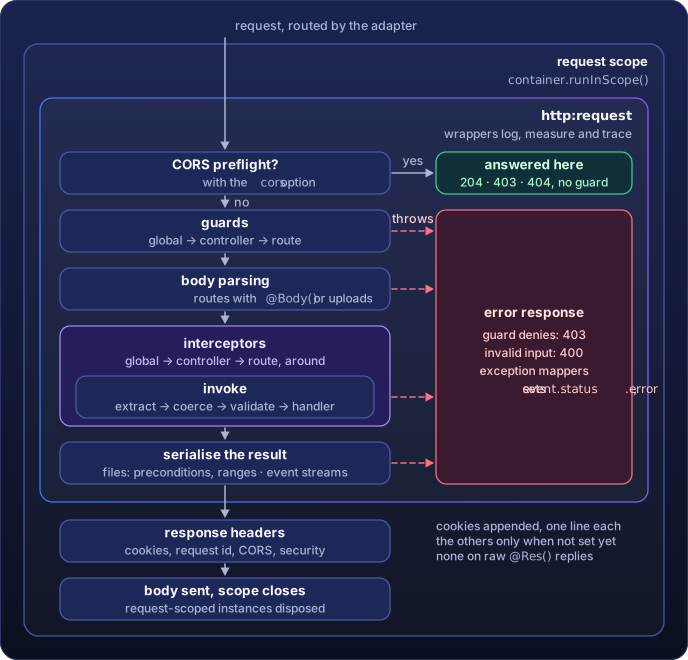
Observers such as @znight/observability wrap http:request to log, measure and trace every request.
Plugin options
HttpPlugin.configure(options), or HttpPlugin.configure(container => options):
| Option | Default | Description |
|---|---|---|
adapter | nodeAdapter() | fastifyAdapter(), expressAdapter(), honoAdapter()... |
port, host | 3000, 0.0.0.0 | Listening address (port: 0: a free port) |
prefix | — | Path prefix for every route (/api) |
guards | [] | Global guards (classes or instances) |
interceptors | [] | Global interceptors |
exceptionMappers | [] | Map error types to responses |
trailingSlash | 'strict' | 'strict', 'ignore' or 'redirect' |
exposeErrors | false | Include messages of unexpected errors in 500 responses |
bodyLimit | 1 MiB | Maximum request body size (bytes or '10mb') |
uploads | see Files | { maxFileSize, maxFiles, maxParts, maxFieldSize } |
requestIdHeader | x-request-id | Header read and echoed (false: always generate) |
drainTimeoutMs | 4000 | Maximum wait for in-flight requests on shutdown (Infinity: no limit) |
cors | off | CORS policy: { origin, credentials?, methods?, ... } |
securityHeaders | true | Security headers: true, false or settings |
trustProxy | false | Trusted proxies: a hop count or addresses / CIDRs |
enforcement | 'error' | Unenforced route decisions: fail or warn |
cookies | — | { secrets?, defaults? }: signing keys and defaults |
sse | — | { heartbeat?, retry?, shutdownGraceMs? } of event streams |
Plugin routes
Other plugins can serve routes through HttpPlugin (the OpenAPI document, status endpoints) by implementing PluginHttpRoutes: httpRoutes({ prefix, container }) returns { method, path, name, handler, meta?, guards? } entries. They are registered on every adapter in the same pipeline as the controllers (the http:request hook, the global guards, then their own), take their route decisions from meta ([Public.meta()]), and are listed in HttpPlugin.routes with the plugin name as source. A path collision is ZNIGHT007 naming the plugin.
Adapters
| Adapter | Peer dependencies | Notes |
|---|---|---|
nodeAdapter() (@znight/http) | none | Built-in node:http server (also works on Bun) |
fastifyAdapter() (@znight/http/fastify) | fastify | exposeHeadRoutes disabled: Znight serves HEAD |
expressAdapter() (@znight/http/express) | express | Your middleware runs before the Znight routes |
honoAdapter() (@znight/http/hono) | hono, @hono/node-server | Bun.serve() on Bun (serveOptions, no 128 MiB cap), @hono/node-server on Node.js |
Every adapter implements inject(request): requests handled in memory, without a socket, which is what TestApp uses. inject() accepts FormData bodies (uploads) and returns the raw body in bytes (downloads); set-cookie is always an array in its headers. With the node and express adapters it needs light-my-request.
A plugin instance serves one application at a time (a HttpPlugin.configure() shared by the tests of a file works; two running applications sharing it fail with ZNIGHT004), and an adapter instance serves a single application: create adapters per application with the function form, HttpPlugin.configure(() => ({ adapter: fastifyAdapter() })) (ZNIGHT021 otherwise).