
Appearance
Scopes
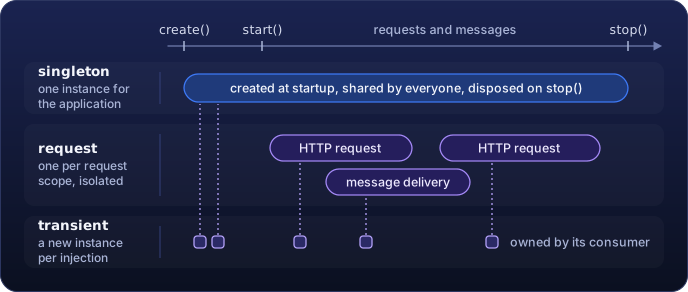
A provider's scope decides how long its instances live.
| Scope | Instances | Typical use |
|---|---|---|
singleton (default) | One for the whole application, created during startup | Services, repositories, clients, controllers |
request | One per request scope (HTTP request, message delivery) | Current user, per-request caches, unit of work |
transient | A new one for every injection (and every container.get()) | Stateful helpers owned by their consumer |
ts
@Injectable({ scope: 'request' })
export class CurrentUser {
  constructor(private readonly context: HttpContext) {}

  get id(): string {
    // read from the request (e.g. a header set by an auth guard)
  }
}

@Injectable({ scope: 'transient' })
export class QueryBuilder {}
Rules between scopes
A provider must not outlive what it depends on. The compiler checks every edge of the graph, including edges through transients, arrays, guards, interceptors and plugin-provided values:
| Dependent ↓ / dependency → | singleton | request | transient |
|---|---|---|---|
| singleton | ✓ | ✗ ZNIGHT003 | ✓ (owns its instance) |
| request | ✓ | ✓ (same scope) | ✓ |
| transient | ✓ | ✓ only when used from a request-scoped consumer | ✓ |
A singleton is created once, at startup, outside of any request: it cannot hold the instance of one particular request. The compiler rejects it:
txt
✗ ZNIGHT003: Scope mismatch: AuditService (singleton) depends on CurrentUser (request)
  --> src/audit/audit.service.ts:7:40
   = hint: Inject Lazy<CurrentUser> and call get() while handling a request
   = hint: Or make AuditService request-scoped
Using request data from a singleton: Lazy<T>
Most services should stay singletons. When one needs the current request's data, inject a Lazy<T> handle and resolve it while the request is being handled:
ts
@Injectable()
export class AuditService {
  constructor(
    private readonly log: AuditLog,
    private readonly currentUser: Lazy<CurrentUser>,
  ) {}

  async record(action: string) {
    await this.log.append({ action, userId: this.currentUser.get().id }) // this request's CurrentUser
  }
}
Alternatively, pass the value as a method argument, or make the consumer request-scoped (its own dependents then need to be request-scoped or use Lazy too).
Request scopes
Request scopes are opened by plugins: @znight/http opens one per HTTP request and @znight/messaging one per message delivery. Inside, request-scoped providers are created on first use and shared by everything resolved in the same scope; concurrent requests never share instances (scopes are isolated with AsyncLocalStorage).
Plugins seed the scope with request-scoped externals, such as HttpContext or InboundMessage, that your request-scoped providers can inject.
You can open a scope yourself, for example in a script or a custom plugin:
ts
const report = await app.container.runInScope(
  async () => app.container.get(ReportService).generate(),
  [['@acme/jobs#JobContext', { jobId: 'nightly-report' }]], // seed values: [token or class, value]
)- When
fnsettles, instances created in the scope are disposed in reverse creation order ([Symbol.asyncDispose]()/[Symbol.dispose]()). container.currentScope()returns the active scope (get,set,has), orundefined.- Resolving a request-scoped provider outside of any scope throws
ZNIGHT013. So does resolving it after the scope closed: await everything a request starts inside therunInScope()callback.
Transient providers
A transient provider gives every consumer its own instance. Use it for objects with per-consumer state:
ts
@Injectable({ scope: 'transient' })
export class RateLimiter {
  #tokens = 10
  tryAcquire(): boolean {
    return this.#tokens-- > 0
  }
}

@Injectable()
export class EmailService {
  constructor(private readonly limiter: RateLimiter) {} // its own RateLimiter
}
Transient instances belong to their consumer: the container never calls their lifecycle hooks nor disposes them.
Async providers and scopes
Async factories (@Provides() returning Promise<T>) are awaited once, during startup, so they are only allowed for singletons. An async request-scoped or transient factory is ZNIGHT014: make it a singleton, or provide a synchronous object with async methods (a connection pool rather than a connection).
Controllers and consumers
Controllers and consumers are singletons by default, which is the fastest option. They accept a scope too, for example @Controller({ path: '/me', scope: 'request' }); prefer Lazy<T> or request-scoped collaborators when only part of the logic needs request data.