
Appearance
The compiler
@znight/compiler is the heart of Znight. It reads your TypeScript sources, understands decorators and types, binds every dependency, validates the graph and writes a plain TypeScript module that the runtime executes. It runs as a Vite plugin, from the CLI (znight generate), as a Bun preload, or programmatically.
How it works
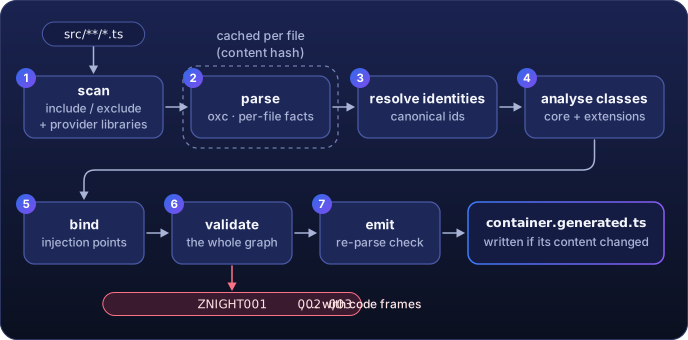
- Scan the files matched by
include/exclude, plus provider libraries. - Parse them with oxc (a native parser) and extract per-file facts: imports, exports, declarations. Both are cached by content hash, so a rebuild only re-parses what changed.
- Resolve identities: every class, interface and decorator gets a canonical identity (
src/users/user.service.ts#UserService,@znight/http#Get) independent of how it is imported. - Analyse classes: decorators are recognised by identity (renamed imports and barrels work), constructor parameter types are resolved, decorator arguments are evaluated statically. Feature packages contribute compiler extensions (routes, consumers, config classes).
- Bind every injection point to a provider (algorithm).
- Validate the graph: missing providers, cycles, scope mismatches, ambiguities... (error codes).
- Emit the module (deterministic output), re-parse it as a safety check, and write it only if its content changed.
Only parsing and per-file facts are cached; everything from resolution onwards is recomputed on each compile, which is cheap and keeps incremental builds correct.
What the compiler reads
- Decorators as markers: they are never executed. Static arguments (paths, names, scopes, queue and env names) must be evaluable at build time: literals,
constreferences across files and packages, template literals, arithmetic,as const... Value arguments (schemas, guards, options) are evaluated when possible, otherwise they must reference an exported binding, which the generated module imports. - Types of constructor and
@Providesparameters,extends/implementsclauses (with generic arguments), and method signatures for routes and handlers.
ts
export const API_PREFIX = '/api/v1'

@Controller(`${API_PREFIX}/users`) // ✓ evaluated: '/api/v1/users'
export class UserController {}

@Controller(process.env.PREFIX) // ✗ ZNIGHT005: not statically evaluable
export class AdminController {}
Options
The Vite plugin (znight(options)), the Bun preload, znight generate and compile() / generate() take the same options. Keep them in a znight.config.ts (what znight new generates): the Bun preload and znight generate read it, and vite.config.ts passes it to the plugin, so every tool generates the same container.
ts
import type { ZnightOptions } from '@znight/compiler'

export default {
  include: ['src/**/*.ts'],
  strictValidation: true,
} satisfies ZnightOptions
ts
import { znight } from '@znight/compiler'
import { defineConfig } from 'vite'

import options from './znight.config.ts'

export default defineConfig({ plugins: [znight(options)] })
znight.config.ts (or .mts, .js, .mjs) default-exports the options, or a function returning them; the ZNIGHT_CONFIG environment variable names another file. A relative root is resolved against the file's directory.
| Option | Type | Default | Description |
|---|---|---|---|
root | string | Vite root / process.cwd() | Project root. Globs and outFile are relative to it. |
include | string[] | ['src/**/*.{ts,tsx,mts}'] | Sources to analyse. |
exclude | string[] | ['**/*.{test,spec}.*', '**/*.d.ts', '**/.znight/**'] | Excluded from include and provider libraries. node_modules, dot-directories and outFile are always excluded. |
outFile | string | 'src/.znight/container.generated.ts' | The generated module. |
tsconfig | string | false | nearest tsconfig of each file | tsconfig used for paths resolution, or false to ignore tsconfig files. |
conditions | string[] | [] | Extra export conditions used to find sources (e.g. a workspace "source" condition). |
importExtension | 'js' | 'ts' | 'none' | 'js' | Extension of relative imports in the generated module. |
sourceLocations | 'dev' | 'always' | false | 'dev' | Emit provider source locations (used in runtime errors) in serve/test only, always, or never. |
stripDecorators | boolean | true | Remove Znight decorators from the bundle. |
extensions | CompilerExtension[] | [] | Additional compiler extensions. |
trustedExtensions | string[] | [] | Third-party packages allowed to load a compiler extension from their manifest. |
externals | string[] | [] | Identities provided at runtime by your own plugins ('src/clock.ts#Clock', '@acme/x#Y'). |
libraries | string[] | [] | Packages analysed from source (provider libraries). |
library | boolean | false | Library mode: emit dist/znight.providers.json. |
strictValidation | boolean | false | Unvalidated inputs (ZNIGHT017) are errors instead of warnings. |
reportUnused | boolean | false | Warn about providers unreachable from any root (ZNIGHT019). |
prune | boolean | false | Drop unreachable providers from the generated module. |
app | false | { entry?: string } | {} (entry 'src/main.ts') | Vite build defaults for a server application, or false to leave the Vite config alone. |
The generated module
The output is a regular TypeScript module exporting __ZNIGHT_METADATA__ (also the default export):
ts
// AUTO-GENERATED by @znight/compiler 0.1.0. Do not edit.
// biome-ignore-all lint: generated file
/* eslint-disable */
import type { ZnightMetadata } from '@znight/core'
import type { HttpContext } from '@znight/http'
import { coerce } from '@znight/http'
import { DbFactory } from '../db/db.factory.js'
import { PgUserRepository } from '../users/pg-user.repository.js'
import { UserController } from '../users/user.controller.js'
import { UserService } from '../users/user.service.js'

export const __ZNIGHT_METADATA__: ZnightMetadata = {
  version: 1,
  compiler: '0.1.0',
  providers: {
    ['src/db/db.factory.ts#DbFactory']: {
      scope: 'singleton',
      class: DbFactory,
      deps: [],
      factory: () => new DbFactory(),
    },
    ['src/db/db.factory.ts#DbFactory.createPool']: {
      scope: 'singleton',
      deps: ['src/db/db.factory.ts#DbFactory'],
      factory: d => d[0].createPool(),
    },
    ['src/users/pg-user.repository.ts#PgUserRepository']: {
      scope: 'singleton',
      class: PgUserRepository,
      deps: ['src/db/db.factory.ts#DbFactory.createPool'],
      factory: d => new PgUserRepository(d[0]),
    },
    ['src/users/user.controller.ts#UserController']: {
      scope: 'singleton',
      class: UserController,
      deps: ['src/users/user.service.ts#UserService'],
      factory: d => new UserController(d[0]),
    },
    ['src/users/user.service.ts#UserService']: {
      scope: 'singleton',
      class: UserService,
      deps: [
        'src/users/pg-user.repository.ts#PgUserRepository',
        '@znight/observability#Logger',
        '@znight/observability#LoggedInterceptor',
      ],
      factory: d => new UserService(d[0], d[1]),
      interceptors: { ['findById']: { async: true, chain: [{ dep: 2, options: { ['level']: 'debug' } }] } },
    },
  },
  resolutionOrder: [
    'src/db/db.factory.ts#DbFactory',
    'src/db/db.factory.ts#DbFactory.createPool',
    'src/users/pg-user.repository.ts#PgUserRepository',
    'src/users/user.service.ts#UserService',
    'src/users/user.controller.ts#UserController',
  ],
  aliases: {
    ['src/db/db.factory.ts#Pool']: 'src/db/db.factory.ts#DbFactory.createPool',
    ['src/users/user.repository.ts#UserRepository']: 'src/users/pg-user.repository.ts#PgUserRepository',
  },
  externals: [
    { token: '@znight/observability#LoggedInterceptor', providedBy: 'ObservabilityPlugin' },
    { token: '@znight/observability#Logger', providedBy: 'ObservabilityPlugin' },
  ],
  extensions: {
    ['http']: {
      ['controllers']: [
        {
          ['token']: 'src/users/user.controller.ts#UserController',
          ['basePath']: '/users',
          ['guards']: [],
          ['interceptors']: [],
          ['meta']: {},
          ['routes']: [
            {
              ['method']: 'GET',
              ['path']: '/:id',
              ['fullPath']: '/users/:id',
              ['handler']: 'getUser',
              ['meta']: {},
              ['guards']: [],
              ['interceptors']: [],
              ['params']: [{ ['index']: 0, ['source']: 'param', ['name']: 'id', ['type']: 'number' }],
              ['invoke']: (c: UserController, ctx: HttpContext) =>
                c.getUser(coerce.number(ctx.params['id'], 'param "id"')),
            },
          ],
        },
      ],
    },
  },
}
export default __ZNIGHT_METADATA__
Properties of the output:
- Readable: factories are ordinary
new X(...)calls (d => d[0].createPool()for a@Providesmethod); route handlers are ordinary method calls. Put a breakpoint in it. - Safe keys: every key that comes from your code or from an extension (tokens, method names, extension data) is a computed string key (
['findById']), so names such as__proto__stay plain properties. - Type-checked: it compiles under strict settings (
exactOptionalPropertyTypes,noPropertyAccessFromIndexSignature,verbatimModuleSyntax...), andinvokekeeps typed parameters, so a handler signature that does not match its decorators failstsc. - Deterministic: no timestamps, stable ordering, identical on every OS and for incremental and full builds. Diffs are meaningful.
- Lean: source locations are omitted from production bundles (
sourceLocations: 'dev'). The file on disk is the same whatever the mode (theserverendering, with locations), soznight generate,vite build, the Bun preload andznight generate --checkagree on it.
The Vite plugin
ts
import { znight } from '@znight/compiler'
import { defineConfig } from 'vite'

import options from './znight.config.ts'

export default defineConfig({ plugins: [znight(options)] })
The plugin keeps one incremental compiler for the server environments of Vite (SSR builds, Vitest's Node.js environment); client environments are left alone.
- Server builds by default. Unless you configured
build.ssrorbuild.libyourself (or setapp: false), the plugin setsbuild.ssrtosrc/main.ts(app.entry),build.outDirtodist,build.targettonode24, enables source maps and targets Node. Values you set are kept. vite buildcompiles before bundling. Any error fails the build with the formatted diagnostics and nothing is written. Provider source locations are omitted (buildmode).vite build --watch(whatznight devruns) and the dev server recompile only the files that changed (events are debounced) and print the diagnostics. While there are errors, the generated module is replaced by one that throws aZnightErrorwith the diagnostics when imported: the bundle is still written, so a broken graph never runs silently, andznight devkeeps the last good process running instead of restarting into the error.- Vitest uses your Vite config: the container is compiled (
testmode) before the tests import it and recompiled in watch mode. - Decorator stripping: the Znight decorators found by the analysis are removed from the transformed code, with high-resolution source maps. Only the exact ranges recorded for that file content are removed; files that were not analysed, and your other decorators, are untouched.
- The generated module is served from memory (also before it exists on disk, on a fresh checkout); the copy on disk exists for
tscand your editor, is only rewritten when its content changes and never while there are errors. A read-only file system (a container image) only gives a warning. Import it by path (relative), not through an alias. - Watching: besides the
includeglobs, every file the analysis read is watched (a constant imported fromshared/, a type ofsrc/types.d.ts), and creating a file where a relative import did not resolve recompiles. - Tools read the plugin state through
plugin.api:options,compiler,result(the latest compile result) andready()(compiles the pending changes).
Diagnostics
Diagnostics are printed with a code frame and hints:
txt
✗ ZNIGHT001: Missing provider for 'EmailService' required by NotificationService
  --> src/notification/notification.service.ts:12:29
   |
12 |     private readonly email: EmailService,
   |                             ^^^^^^^^^^^^
   = hint: EmailService (src/email/email.service.ts:3) is not a provider: add @Injectable()
Errors fail the build; warnings (such as ZNIGHT017 without strictValidation) are printed and the build continues. Every code is documented in the error reference.
Git and CI
The generated module is derived from your sources: do not commit it.
txt
.znightGenerate it before anything that needs it without going through Vite:
sh
znight generate          # write src/.znight/container.generated.ts
znight generate --check  # CI: exit 1 when the file is missing or stale
znight generate --watch  # keep it up to date for your editor
A typical CI pipeline:
sh
znight generate   # or let `vite build` do it
tsc --noEmit
bun test          # or vitest
vite build
Development workflow
znight dev runs the Vite build in watch mode and restarts the process after every successful rebuild. There is no partial hot replacement of providers: a restart is fast (no reflection, a precomputed graph) and always consistent.
json
{
  "scripts": {
    "dev": "znight dev",
    "build": "znight build",
    "start": "znight start"
  }
}
Bun preload
Bun runs TypeScript (decorators included) directly. The compiler's Bun preload regenerates the container before your tests or your application start, and serves it from memory:
toml
[test]
preload = ["@znight/compiler/bun"]
sh
bun test                                                           # regenerated before the tests run
bun --preload @znight/compiler/bun --no-env-file --watch src/main.ts  # before the app starts, on every restart
The preload reads znight.config.ts, generates the container (test mode under bun test, build with NODE_ENV=production, serve otherwise; the disk copy, the same in every mode, is written when it changed — a read-only file system only gives a warning, but the import resolves only when the file exists: generate it when you build an image), prints the diagnostics on stderr and, on errors, throws a ZnightError: bun test exits with code 1 and bun --watch waits for a fix. --no-env-file keeps Bun from loading .env files into process.env itself (why). The Znight decorators of the analysed files are blanked out (replaced by spaces: line and column numbers are unchanged, no source map needed).
Bun restarts --watch processes only for files it loaded: the preload makes Bun watch every file the container depends on (also after a failed compile), but a newly created provider file is picked up at the next restart. The preload-only option logLevel ('info' adds a summary line, 'warn' by default, 'silent') goes in znight.config.ts too.
Importing @znight/compiler/bun runs the preload. Custom preload files use the side-effect-free functions of the package root:
ts
// preload.ts (bunfig.toml: preload = ["./preload.ts"])
import { createPreload, loadZnightConfig } from '@znight/compiler'

const { options } = await loadZnightConfig()
await createPreload({ ...options, logLevel: 'info' })
Under Vitest, the Vite plugin plays the same role.
Programmatic API
ts
import { compile, formatDiagnostics, generate } from '@znight/compiler'

// Analyse and generate in memory: reads sources, writes nothing
const result = await compile({ root: process.cwd() })
console.log(formatDiagnostics(result.diagnostics, { color: true }))
console.log(result.stats) // { files, providers, durationMs, parsed }

// Same, and write outFile (or only check it is up to date)
await generate({ check: process.env.CI === 'true' })| Export | Description |
|---|---|
znight(options) | The Vite plugin (also the default export) |
compile(options) | Pure compile: { ok, code, diskCode, outFile, diagnostics, graph, stats, watchFiles, decorators } |
generate(options) | Compile and write outFile (diskCode, the same in every mode) when it changed (written); check: true only compares (stale, staleFiles) |
createCompiler(options) | Incremental compiler for watchers: compile(changes) / generate(changes) re-read only changed files |
formatDiagnostics | Pretty-prints diagnostics with code frames ({ color?, cwd?, summary? }) |
renderErrorModule | The module served instead of the container when the compilation fails |
createPreload(options) | The Bun preload with these options (Bun only) |
znightBunPlugin(options) | The Bun plugin alone: serves the container from memory, blanks the decorators |
loadZnightConfig(cwd?) | { file, options } of znight.config.* / ZNIGHT_CONFIG |
Provider libraries
Providers can live in other packages of a monorepo, or in published libraries.
Source libraries are analysed from their TypeScript sources, like your own code. Opt in with the libraries option or from the library's manifest:
json
{
  "name": "@acme/auth",
  "exports": { ".": "./src/index.ts" },
  "znight": { "apiVersion": 1, "library": "source" }
}
Compiled libraries are built with library: true: the compiler emits dist/znight.providers.json (providers, scopes, injection points, heritage, interceptors, extension data). The library references it from its manifest and applications merge it before binding:
json
{
  "znight": { "apiVersion": 1, "providers": "./dist/znight.providers.json" }
}
Library providers get package identities (@acme/auth#JwtService) and are imported from the package's public entry: never through a path into the package.
Compiler extensions
Feature packages teach the compiler new decorators through extensions: @znight/http analyses controllers and routes, @znight/messaging consumers, @znight/config config classes. They are found through each package's manifest ("znight": { "compiler": "@znight/http/compiler" }), so installing the package is enough. Third-party extensions must be listed in trustedExtensions.
Writing an extension is an advanced topic covered by the specification.