
Appearance
Dependency injection
Znight wires your application from type annotations. You declare what a class needs in its constructor; the compiler finds a provider for each parameter, checks the whole graph and generates the code that creates everything in the right order.
Providers
A provider is a class the container instantiates. Declare it with @Injectable() and export it:
ts
import { Injectable } from '@znight/core'

@Injectable()
export class PasswordHasher {
  hash(password: string): Promise<string> {
    // ...
  }
}
@Injectable() accepts static options:
| Option | Default | Description |
|---|---|---|
scope | 'singleton' | 'singleton', 'request' or 'transient' (see Scopes) |
name | — | A qualifier, same as @Named() |
primary | false | Preferred candidate, same as @Primary() |
Other decorators also declare providers: @Controller() (HTTP), @Consumer() (messaging), @Config() (config), @Factory() (below).
Arguments must be static
Decorators are read by the compiler, not executed. Options such as scope or name must be statically evaluable: literals, const references (even imported), simple expressions. Something like @Injectable({ scope: process.env.SCOPE }) is rejected with ZNIGHT005.
Constructor injection
Each constructor parameter is a dependency. Parameter properties or plain parameters both work:
ts
@Injectable()
export class SignupService {
  readonly #mailer: Mailer

  constructor(
    private readonly users: UserRepository, // parameter property
    private readonly hasher: PasswordHasher,
    mailer: Mailer, // plain parameter
  ) {
    this.#mailer = mailer
  }
}
Rules worth knowing:
- Every parameter needs a type annotation the compiler can resolve to a declaration. Function types, object literal types or
typeof xare opaque:ZNIGHT010. import typeis fine: only the generated module imports values.- A class without its own constructor inherits the nearest one in its
extendschain, with type arguments substituted (class UserRepo extends Repository<User>). extends Mixin(Base)cannot be analysed: declare an explicit constructor.
Tokens
Every provider is identified by a token: the canonical identity of its declaration.
| Provider | Token |
|---|---|
| Class in your application | src/users/user.service.ts#UserService |
| Class exported by a package | @acme/auth#JwtService |
@Provides method | src/db/db.factory.ts#DbFactory.createPool |
| Provided at runtime by a plugin | @znight/observability#Logger |
Two classes named UserService in different files never collide. Error messages use the display name (the part after #). You rarely write tokens yourself: the public API is class-first.
Injecting interfaces and base classes
Interfaces and abstract classes are first-class injection types. The compiler collects the implements / extends closure of every provider and binds the parameter to the provider that matches:
ts
export interface PaymentGateway {
  charge(cents: number, card: string): Promise<string>
}

@Injectable()
export class StripeGateway implements PaymentGateway {
  async charge(cents: number, card: string): Promise<string> {
    // ...
  }
}

@Injectable()
export class CheckoutService {
  constructor(private readonly payments: PaymentGateway) {} // → StripeGateway
}
Generic types are matched with their type arguments, so Repository<User> and Repository<Order> are different injection types:
ts
export abstract class Repository<T> {
  abstract findById(id: string): Promise<T | undefined>
}

@Injectable()
export class UserRepository extends Repository<User> {
  /* ... */
}

@Injectable()
export class AuditService {
  constructor(private readonly users: Repository<User>) {} // → UserRepository
}
The binding is structural only through declarations
Znight matches on declared heritage (implements, extends), not on structural compatibility: a class that happens to have the right methods but no implements PaymentGateway clause is not a candidate. The ZNIGHT001 message points it out when it finds such a near miss.
Several implementations: @Primary()
When several providers match an interface, the injection is ambiguous (ZNIGHT008). Mark the default one with @Primary():
ts
@Injectable()
@Primary()
export class StripeGateway implements PaymentGateway {}

@Injectable()
export class PaypalGateway implements PaymentGateway {}

@Injectable()
export class CheckoutService {
  constructor(private readonly payments: PaymentGateway) {} // → StripeGateway
}
You can always inject a concrete class directly (PaypalGateway): an exact match wins over classes that merely implement the type.
Qualifiers: @Named() and @Inject()
Name providers with @Named() (or the name option) and select one at the injection point with @Inject():
ts
@Injectable()
@Named('stripe')
export class StripeGateway implements PaymentGateway {}

@Injectable()
@Named('paypal')
export class PaypalGateway implements PaymentGateway {}

@Injectable()
export class RefundService {
  constructor(@Inject('paypal') private readonly payments: PaymentGateway) {}
}
The qualifier narrows the candidates of the declared type: @Inject('paypal') x: PaymentGateway only considers PaymentGateway providers named paypal.
Primitives and values
string, number and other primitives say nothing about which value you want, so they always need a qualifier. Provide the value with a named @Provides method:
ts
@Factory()
export class ApiFactory {
  @Provides({ name: 'apiBaseUrl' })
  apiBaseUrl(): string {
    return 'https://api.example.com/v2'
  }
}

@Injectable()
export class ApiClient {
  constructor(@Inject('apiBaseUrl') private readonly baseUrl: string) {}
}
For configuration values, prefer typed @Config() classes: they are injected by class, validated at boot and testable.
Multi injection
A parameter typed as an array receives every matching provider:
ts
export interface HealthIndicator {
  check(): Promise<{ name: string; healthy: boolean }>
}

@Injectable()
export class DatabaseHealth implements HealthIndicator {}

@Injectable()
export class CacheHealth implements HealthIndicator {}

@Injectable()
export class HealthService {
  constructor(private readonly indicators: HealthIndicator[]) {} // [CacheHealth, DatabaseHealth]

  async report() {
    return Promise.all(this.indicators.map(indicator => indicator.check()))
  }
}
Multi injection never fails: with no provider you get an empty array. Providers are ordered by token (deterministic, by file path); sort them yourself if order matters. A qualifier (@Inject('x')) filters the list.
Optional dependencies
A dependency is optional when it is marked with ?, typed | undefined or | null, has a default value, or is decorated with @Optional(). Without a provider, undefined is injected instead of failing the build:
ts
@Injectable()
export class ReportService {
  constructor(
    private readonly db: Database,
    @Optional() private readonly tracer: Tracer | undefined,
    private readonly cache?: Cache, // undefined when no Cache provider exists
  ) {}
}
Lazy dependencies
Lazy<T> injects a handle instead of the instance. get() resolves the dependency when called, in the current scope:
ts
import { Injectable, type Lazy } from '@znight/core'

@Injectable()
export class OrderService {
  constructor(private readonly payments: Lazy<PaymentService>) {}

  async place(order: Order) {
    await this.payments.get().charge(order) // resolved now, not at construction
  }
}
It is the escape hatch for two situations the compiler otherwise rejects:
- cycles (
ZNIGHT002):A → B → Abecomes legal when one of the edges is lazy; - a singleton using a request-scoped value (
ZNIGHT003):Lazy<CurrentUser>resolves the instance of the request being handled. See Scopes.
Do not call get() from a constructor or a factory: call it later, in a method or in onStart().
Factories: @Factory() and @Provides()
Some objects are not your classes (database pools, SDK clients) or need setup code. Declare them with a @Factory() class whose @Provides() methods build them:
ts
import { Factory, Provides } from '@znight/core'
import { Pool } from 'pg'

@Factory()
export class DatabaseFactory {
  constructor(private readonly config: DatabaseConfig) {}

  @Provides({ dispose: 'end' })
  async createPool(): Promise<Pool> {
    const pool = new Pool({ connectionString: this.config.url })
    await pool.query('select 1') // fail fast at boot
    return pool
  }
}

@Injectable()
export class PgUserRepository implements UserRepository {
  constructor(private readonly pool: Pool) {} // the resolved Pool, not a promise
}- The explicit return type is what the method provides.
Promise<T>makes the provider async: it is awaited during startup and consumers receiveT. Async factories are only allowed for singletons (ZNIGHT014). - Method parameters are injected like constructor parameters (qualifiers, optional and
Lazyincluded). @Provides()acceptsscope,name,primaryanddispose, the name of a method called on shutdown ('end','close','quit'...). Without it,[Symbol.asyncDispose]()/[Symbol.dispose]()are used when present.- The factory class itself is a singleton provider;
@Providesoutside a@Factory()is an error.
Independent async factories start concurrently during init(): a database pool and a Redis client connect in parallel.
Values supplied at runtime (externals)
Some types are provided at runtime rather than compiled: the Logger of @znight/observability, the request's HttpContext, MessageBroker... Packages declare them in their manifest, so injecting them just works; the generated metadata lists them as externals and the container checks at boot that the corresponding plugin supplied them:
ts
import { Logger } from '@znight/observability'

@Injectable()
export class UserService {
  constructor(private readonly logger: Logger) {} // supplied by ObservabilityPlugin
}
Forgot the plugin? Application.create() fails with ZNIGHT001 naming it.
You can also supply or replace values yourself when creating the application:
ts
const app = await Application.create({
  metadata: __ZNIGHT_METADATA__,
  providers: [[Clock, systemClock]], // keys: classes or tokens
})
Your own runtime-provided types (supplied by a custom plugin) are declared to the compiler with the externals option: znight({ externals: ['src/clock.ts#Clock'] }). See Plugins.
Resolving from the container
You rarely need it outside of main.ts, plugins and tests, but the container is available:
ts
const container = app.container

container.get(UserService) // by class
container.get(Repository) // abstract class → its only (or primary) implementation
container.get('PaymentGateway') // interface or class, by unique display name (or full token)
container.getOptional(Cache) // undefined when there is no provider
container.has(Cache)
container.tokenOf(UserService) // 'src/users/user.service.ts#UserService'
Providers can inject the container itself (Container from @znight/core), as well as the Application, Hooks and the core logger.
How a dependency is bound
For each injection point of type T (with an optional qualifier), the compiler applies the same algorithm:
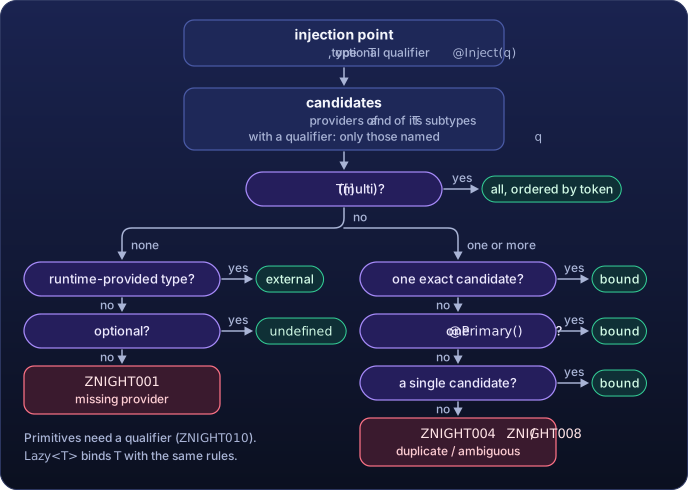
- Candidates: providers providing exactly
T, plus providers whoseextends/implementsclosure containsT. - Qualifier: with
@Inject('q'), keep only candidates namedq. - Array (
T[]): inject every candidate, ordered by token. - Single: one exact candidate → bound; otherwise the unique
@Primary()→ bound; otherwise a single candidate → bound; otherwise several providers of the same type →ZNIGHT004, several implementations →ZNIGHT008. - No candidate: a type declared as runtime-provided by a package → external; an optional dependency →
undefined; otherwiseZNIGHT001, with hints about near misses (same name in another file, missing@Injectable(), excluded file, missingimplements...). - Primitives require a qualifier (
ZNIGHT010otherwise). Lazy<T>bindsTwith the same rules.
The full specification lives in the architecture document.