
Appearance
Lifecycle
An application goes through three calls: Application.create(), app.start() and app.stop(). Providers take part by implementing lifecycle methods; plugins have hooks at every step.
ts
const app = await Application.create({ metadata: __ZNIGHT_METADATA__, plugins }) // build
await app.start() // accept traffic
// ...
await app.stop() // graceful shutdown (also triggered by SIGINT / SIGTERM)
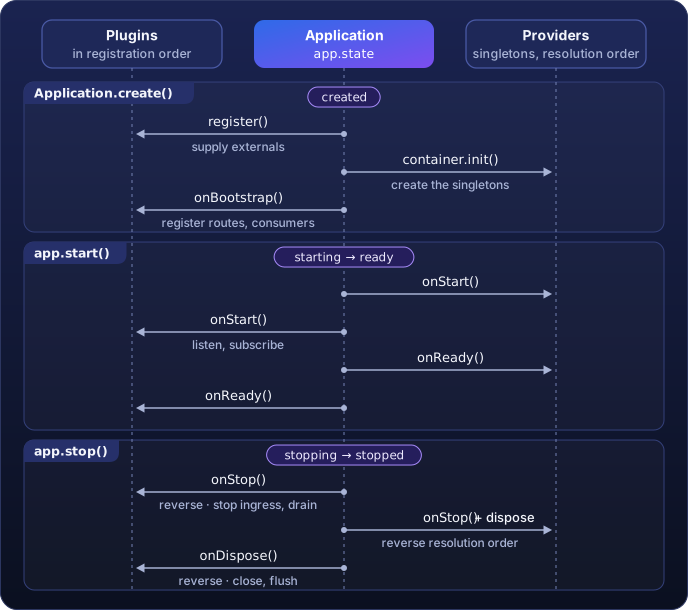
Each call runs the plugin and provider hooks in a fixed order:
Provider hooks
Singletons are duck-typed: implement a method and it is called, no registration needed. The interfaces are optional, they only help the type checker.
ts
import { Injectable, type OnReady, type OnStart, type OnStop } from '@znight/core'

@Injectable()
export class Scheduler implements OnStart, OnReady, OnStop {
  #timer: NodeJS.Timeout | undefined

  async onStart() {
    // dependencies have started; plugins do not accept traffic yet
    await this.loadJobs()
  }

  onReady() {
    // every provider and plugin started
    this.#timer = setInterval(() => this.tick(), 60_000)
  }

  onStop() {
    // shutdown: called before the providers this one depends on stop
    clearInterval(this.#timer)
  }
}| Hook | When | Order |
|---|---|---|
onStart() | app.start(), before plugins start accepting traffic | Resolution order (dependencies first) |
onReady() | app.start(), once every provider and plugin started | Resolution order |
onStop() | app.stop(), after plugins stopped accepting traffic | Reverse resolution order |
dispose / Symbol.asyncDispose | app.stop(), and when a failed boot is rolled back | Reverse resolution order |
Hooks may be async; each one is awaited before the next. Hooks must not require parameters and must be instance methods (ZNIGHT009). Request-scoped and transient instances do not receive onStart/onReady/onStop.
Disposal
Release what a constructor or a factory acquired in a dispose method. Unlike onStop(), disposal also runs when the application was never started, or failed to start:
ts
@Injectable()
export class RedisCache {
  readonly #client = createClient()

  async [Symbol.asyncDispose]() {
    await this.#client.quit()
  }
}

@Factory()
export class DatabaseFactory {
  @Provides({ dispose: 'end' }) // calls pool.end() on shutdown
  async createPool(config: DatabaseConfig): Promise<Pool> {
    return new Pool({ connectionString: config.url })
  }
}
The container calls the dispose method named with @Provides({ dispose }), otherwise [Symbol.asyncDispose](), otherwise [Symbol.dispose](). Values you register yourself (providers, overrides, registerValue) are never disposed by the container: you own them.
Boot: Application.create()
- Creates the container from the metadata and supplies your
providers. - Runs every plugin's
register()(in order): plugins supply their externals. - Applies
overrides(highest precedence, ideal for tests). container.init(): validates the merged graph and creates every singleton. A factory starts as soon as its dependencies are ready, so independent async singletons are created concurrently.- Runs every plugin's
onBootstrap()(routes and consumers are registered, no traffic yet).
If any step fails, everything created so far is disposed (plugins receive onDispose()) and the error is rethrown. A failing factory gives a ZNIGHT015 error with the dependency path and the original cause.
Start: app.start()
- Providers'
onStart(), in resolution order. - Plugins'
onStart(): the HTTP server listens, consumers subscribe. - Providers'
onReady(), then plugins'onReady(). app.state === 'ready'.
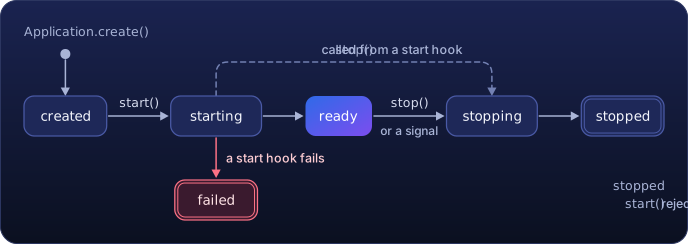
Signal handlers are installed as soon as the start begins, so Ctrl+C during a slow boot shuts down cleanly. If a step fails, what was started is stopped, everything is disposed, app.state becomes 'failed' and the error is rethrown.
Stopping from a start hook
A start hook may stop the application itself: a one-shot job that does its work in onReady(), or a provider giving up in onStart(). Call app.stop() (inject Application), awaited or not:
ts
import { Application, Injectable, type OnReady } from '@znight/core'

@Injectable()
export class MigrationJob implements OnReady {
  constructor(
    private readonly app: Application,
    private readonly migrations: Migrator,
  ) {}

  async onReady() {
    await this.migrations.run()
    await this.app.stop() // the job is done: shut down
  }
}
stop() normally waits for an in-progress start, but the start is waiting for this very hook: called from a start hook (or from work the hook awaits), the shutdown runs right away instead. What completed its onStart() is stopped, the remaining start hooks are skipped, and app.start() resolves once the application is stopped (it rejects if the hook throws afterwards). A SIGTERM received during the boot does not deadlock either.
Graceful shutdown: app.stop()
stop() is idempotent (it waits for an in-progress start, unless a start hook calls it) and runs three phases:
| Phase | What runs | Purpose |
|---|---|---|
| 1 | Plugins' onStop(), in reverse order | Stop ingress, drain in-flight requests and messages |
| 2 | For each provider in reverse resolution order: onStop() (if it started), then disposal | Stop your services, release resources |
| 3 | Plugins' onDispose(), in reverse order | Close connections, flush logs and telemetry |
Every step is attempted even if a previous one failed. Each step has its own timeout (hookTimeoutMs, 5 s by default) and the whole shutdown a global deadline (timeoutMs, 10 s). Infinity disables a budget (so does any value above 2^31 − 1 ms, about 24.8 days, the longest delay a timer accepts); negative and NaN values are rejected (ZNIGHT005). Failures are collected into one ZnightAggregateError (ZNIGHT021) whose errors lists each failed step.
ts
const app = await Application.create({
  metadata: __ZNIGHT_METADATA__,
  plugins,
  shutdown: {
    signals: ['SIGINT', 'SIGTERM'], // default; false disables signal handling
    timeoutMs: 25_000, // global deadline (keep it below your orchestrator's grace period)
    hookTimeoutMs: 5_000, // per step
  },
})
Signals
After start(), SIGINT and SIGTERM trigger app.stop():
- the shutdown logs
Application stoppedonce it completed (atinfoafter a signal, atdebugafter an explicitapp.stop()); - when the signal-triggered shutdown fails,
process.exitCodeis set to1; - a second signal forces
process.exit(130); - an explicit
app.stop()never touches the exit code: your code decides.
Containers and Kubernetes
Run Node.js or Bun as PID 1 with the exec form (CMD ["node", "dist/main.js"]) so it receives SIGTERM, and keep shutdown.timeoutMs below terminationGracePeriodSeconds (30 s by default). See Deployment.
Application states
app.state is one of created, starting, ready, stopping, stopped and failed:
Partial initialisation
init: { only: [...] } creates only the dependency closure of the given providers. Other singletons are created on first use (synchronously, so async factories must be in the closure), outside of any request scope even when a request uses them first. It is handy for CLI commands or serverless handlers that only need part of the graph:
ts
const app = await Application.create({
  metadata: __ZNIGHT_METADATA__,
  init: { only: [ReportService] },
  shutdown: { signals: false },
})
await app.get(ReportService).generate()
await app.stop()
Hot module replacement
When the entry module can be replaced (import.meta.hot), pass it so the application stops before the new one starts:
ts
const app = await Application.create({ metadata: __ZNIGHT_METADATA__, plugins, hot: import.meta.hot })The dispose callback returns the stop() promise: HMR runtimes that await it (Vite's module runner, Bun) load the new module only once the old application released its port and its consumers. A failed stop is logged (Failed to stop the application), not thrown at the HMR runtime.
znight dev restarts the whole process on every rebuild instead, which is the recommended development loop.
Errors attached to errors
When a cleanup fails while handling another error (a dispose failing during a boot rollback, for instance), the cleanup error is attached instead of hiding the original one. Read it with getSuppressedErrors(error):
ts
import { getSuppressedErrors } from '@znight/core'

try {
  await Application.create({ metadata: __ZNIGHT_METADATA__, plugins })
} catch (error) {
  console.error(error)
  for (const cleanup of getSuppressedErrors(error)) console.error('while cleaning up:', cleanup)
  process.exitCode = 1
}