
Appearance
@znight/messaging available
Message consumers for Znight. Consumers are providers whose handlers are analysed by the compiler; the MessagingPlugin subscribes them through a driver: RabbitMQ, Amazon SQS, Kafka, or in memory for tests. Runs on Node.js 24+ and Bun 1.3+.
sh
npm install @znight/messaging amqplib # or @aws-sdk/client-sqs, or @platformatic/kafkats
import { Application } from '@znight/core'
import { MessagingPlugin } from '@znight/messaging'
import { rabbitmq } from '@znight/messaging/rabbitmq'
import { __ZNIGHT_METADATA__ } from './.znight/container.generated.js'

const app = await Application.create({
  metadata: __ZNIGHT_METADATA__,
  plugins: [MessagingPlugin.configure({ driver: rabbitmq({ url: 'amqp://localhost' }) })],
})
await app.start()
Consumers
ts
import { Consumer, type InboundMessage, Message, NonRetryableError, OnError, OnMessage, Retry } from '@znight/messaging'
import { z } from 'zod'

export const OrderCreatedSchema = z.object({ orderId: z.string(), total: z.number() })
export type OrderCreated = z.output<typeof OrderCreatedSchema>

@Consumer('orders')
export class OrderConsumer {
  constructor(private readonly orders: OrderService) {}

  @OnMessage('order.created')
  @Retry({ attempts: 5, backoff: 'exponential', delay: 1_000, maxDelay: 60_000 })
  async onCreated(@Message(OrderCreatedSchema) event: OrderCreated) {
    if (event.total < 0) throw new NonRetryableError('negative total') // straight to the dead-letter queue
    await this.orders.process(event)
  }

  @OnMessage() // default handler: messages without a more specific match
  async onOther(@Message() payload: unknown) {}

  @OnError()
  onFailure(error: unknown, message: InboundMessage): 'ack' | void {
    // the message will not be retried anymore; return 'ack' to drop it instead of dead-lettering it
  }
}| Decorator | Target | Description |
|---|---|---|
@Consumer(queue) / @Consumer({ queue, scope?, concurrency?, deadLetter?, ...driver options }) | class | A provider (singleton by default, scope: 'request' for one instance per message) consuming queue |
@OnMessage(type?) | method | Handles messages of type (exact, or a pattern where * matches anything); without type, the default handler |
@Retry({ attempts, backoff?, delay?, maxDelay? }) | method | Retry policy: attempts counts the first delivery; backoff is 'fixed' or 'exponential' (default) |
@OnError() | method | (error, message) => void | 'ack' when a message will not be retried anymore |
@Message(schema?) | param | The payload, validated by a Standard Schema (Zod, Valibot...) when given |
@Headers(name?) | param | All headers, or one header |
@Ctx() | param | The InboundMessage |
The compiler checks consumers (ZNIGHT011): a consumer needs a handler, two handlers cannot match the same type, retry options must be valid, a queue is consumed by a single @Consumer class. A @Message() parameter without schema is ZNIGHT017 (a warning, an error with strictValidation).
Delivery semantics
Delivery is at least once: handlers must be idempotent.
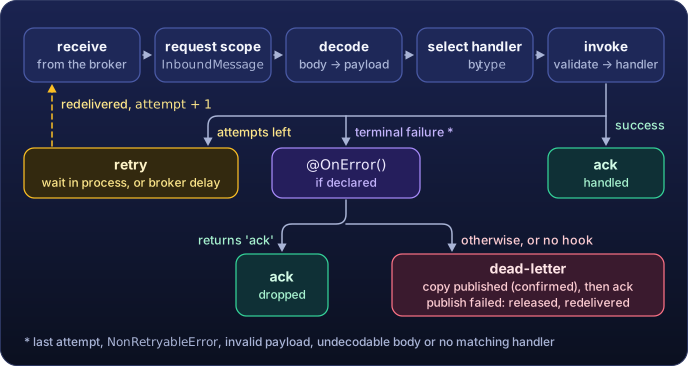
- Each delivery runs in its own request scope (
InboundMessageis a request-scoped external) through themessaging:messagehook. - The handler is selected by
message.type: exact match, then patterns, then the default handler. - Success → ack.
- A retryable failure with attempts left → retry as
attempt + 1, attempts being counted by the broker (ApproximateReceiveCount,x-delivery-count) or anx-znight-attemptheader. Short delays are waited in process (within the driver's budget) and the message is then redelivered through the broker; longer ones use the broker's native mechanism (SQS visibility timeout, RabbitMQ delay queues, Kafka retry topic). The application refuses to boot (ZNIGHT011) if a@Retrypolicy cannot be honoured by the driver. - A terminal failure — last attempt,
NonRetryableError, schema failure (MessageValidationError), undecodable body, no matching handler — runs@OnError: returning'ack'drops the message, anything else (or a throw) dead-letters it. The original message is acked only once the dead-letter publish is confirmed; if that publish fails, the message is released and redelivered.
The dead-letter copy keeps the body, type, id and headers and adds x-znight-dead-letter-reason, x-znight-error, x-znight-original-queue and x-znight-attempts. On shutdown, consumers stop receiving, in-process retry delays are aborted (those messages are released to the broker), message.signal is aborted and in-flight handlers are awaited: messages are never dropped.
Publishing
MessageBroker is provided by the plugin; inject it anywhere:
ts
import { MessageBroker } from '@znight/messaging'

@Injectable()
export class CheckoutService {
  constructor(private readonly broker: MessageBroker) {}

  async complete(order: Order) {
    await this.broker.publish('orders', { orderId: order.id, total: order.total }, { type: 'order.created' })
  }
}
publish(queue, payload, { type?, headers?, key?, delay?, id?, contentType? }) resolves with { id } once the broker confirmed the message; key is the Kafka partition key or the SQS FIFO group, delay is not supported by Kafka.
Drivers
| Driver | Import | Peer dependency | Native delayed retries |
|---|---|---|---|
| In memory | @znight/messaging/memory | — | in process |
| RabbitMQ | @znight/messaging/rabbitmq | amqplib | TTL + dead-letter exchange |
| Amazon SQS | @znight/messaging/sqs | @aws-sdk/client-sqs | visibility timeout |
| Kafka | @znight/messaging/kafka | @platformatic/kafka | retry topic |
A driver implements MessagingDriver { name, capabilities, connect(), subscribe(), publish(), close(), deadLetterName() }; capabilities (nativeDelay, maxNativeDelayMs, maxInProcessDelayMs, deliveryCount, maxPublishDelayMs) let the plugin validate retry policies at boot.
MessagingPlugin.configure({ driver, defaults?, codec?, consume? }): defaults.retry (3 attempts, exponential from 1 s, capped at 30 s; false = a single attempt), defaults.concurrency (1), defaults.deadLetter ((queue) => name or false), defaults.requeueDelay (1 s); consume: false for publish-only processes. Options may be a function of the container; invalid options fail Application.create() with ZNIGHT011.
While consumers are subscribed (from onStart to the end of onStop), the plugin keeps the process alive: a worker whose only ingress is a consumer does not exit after app.start(), whatever the driver (the in-memory one holds no socket), and stops through app.stop() or a signal.
Driver highlights (details in the package README):
- RabbitMQ: delayed publications go through 32 delay levels shared by every queue of the virtual host (
znight.delays.0to.31, optiondelayLevelPrefix), never a queue per delay; retries use per-delay queues bounded by your@Retrypolicies. On RabbitMQ 4+, declared quorum queues getx-delivery-limit: -1(Znight counts the attempts; an existing queue without it gets a warning recommending adelivery-limitpolicy). Lost connections, closed channels and consumers cancelled by the broker are recovered, with backoff, until every consumer consumes again. - Kafka: records fetched again after a rebalance are skipped (commits never move back), and the retry stream has its own back-pressure, so waiting retries never pause the main topic.
- SQS: the lease extension stops before each settlement, so it never overrides a retry delay.
Concurrency
@Consumer({ queue: 'orders', concurrency: 10 }) processes up to ten messages of that consumer at once. Each delivery has its own scope, so request-scoped providers are never shared between messages.
Testing
Use the in-memory driver with TestApp to send messages and assert on outcomes without a broker:
ts
const driver = memory()
await using app = await TestApp.create({ metadata, plugins: [MessagingPlugin.configure({ driver })] })

driver.send('orders', { payload: { orderId: '1', total: 10 }, type: 'order.created' })
await driver.idle()
expect(driver.settlements('orders')).toMatchObject([{ action: 'ack' }])driver.published(), driver.deadLetters(), driver.pending() and driver.fail() (failure injection) complete it. Integration tests against real brokers can use Testcontainers.